
Bordeaux 2025 En Primeur

Last week we were in Bordeaux to taste the 2025 vintage from barrel. After a 2am start in England on the Sunday, we were in the Médoc by mid-morning, tasting at the négociants to gain a first broad impression of the year. From there, the week unfolded in the usual intense but fascinating fashion: visits to many of the top châteaux, hundreds of barrel samples, long discussions with winemakers, and the gradual emergence of a clearer picture of the vintage.
The conclusion is an exciting one. Bordeaux 2025 is a serious, structured year with the potential to rank alongside great vintages like 2005, whilst possessing its own unique character. It is not a vintage of instant charm in the style of some recent “solar” years, but one with impressive tannic architecture, fine fruit, and, in the best wines, a very elegant sense of balance.
After the run of warm, generous vintages such as 2020, 2022 and 2023, with their purity of fruit and often immediate appeal, tasting the 2025s was a reminder that Bordeaux can still deliver wines in a more old-fashioned register, with grip, shape and substance. Some were less open at this early stage, but from long experience we know how often that reserve in youth translates into real ageing potential.
Tannin is central to the character of the vintage. One estate told us that they recorded an IPT (tannin level) of over 100, an extraordinary figure, compared to 70-80 as a more normal figure for a cru classé estate. These tannins give the wines frame and length, and play an important role in their development. Tannins act as natural antioxidants, helping to preserve fruit as the wine evolves in bottle, while allowing more complex savoury, mineral and aromatic elements to emerge over time. This is one reason why young Bordeaux that seems firm or even slightly closed from barrel can later become so rewarding.
Both the Left Bank and Right Bank performed strongly in 2025. The Left Bank produced some magnificent Cabernet-based wines, with classical proportions, freshness and drive. The Right Bank was particularly interesting, not simply for plush Merlot fruit, but for a striking seriousness of structure, contrasting with the more aromatic wines of recent years.
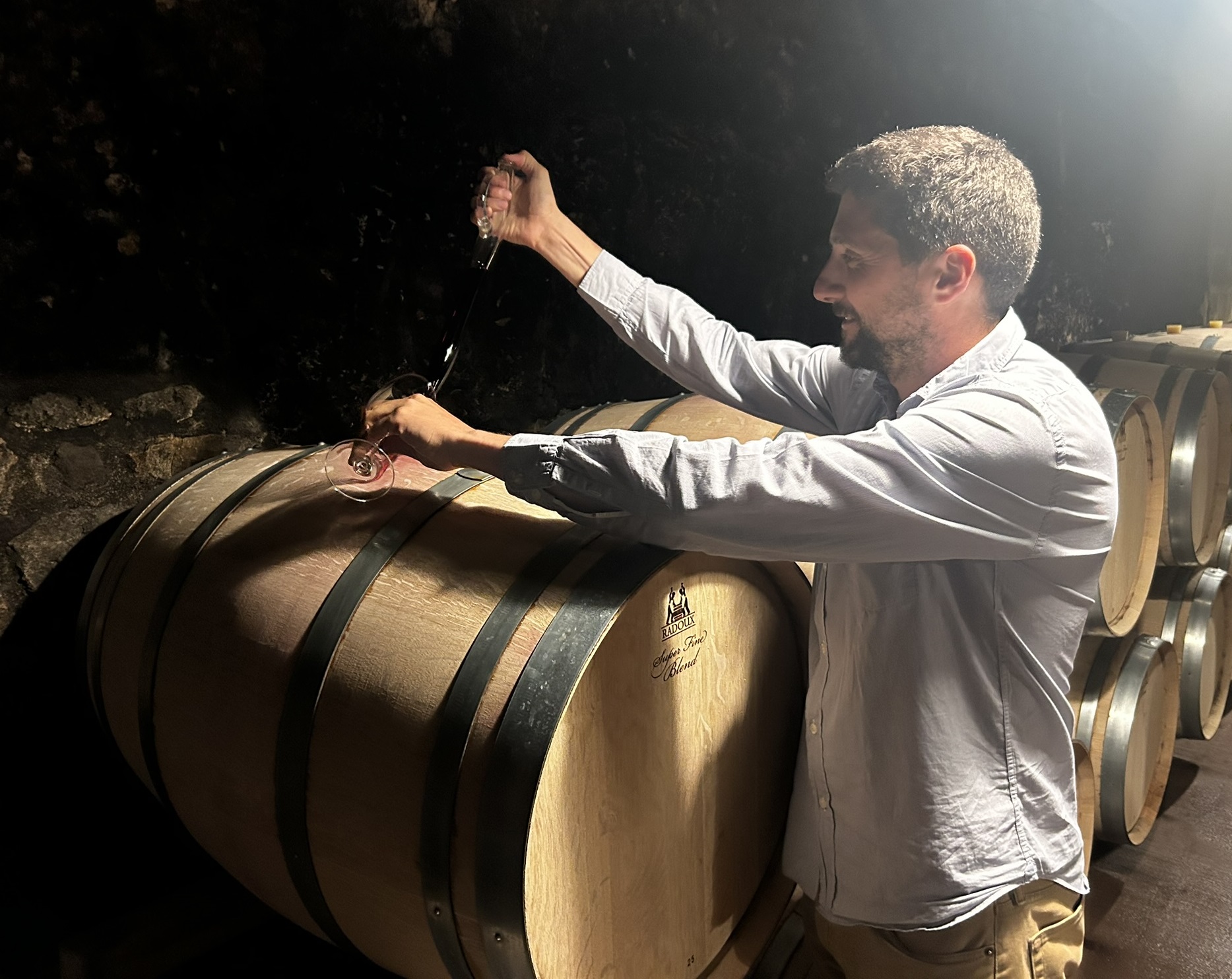
Tasting the 2025 vintage from barrel with Henri Mitjavile at Château Le Tertre Rôteboeuf in St-Emilion
The growing season explains much of this character. Bordeaux experienced a hot, dry summer, with prolonged heat and drought placing pressure on the vines. June was exceptionally warm, and August brought repeated spikes above 35°C in some sectors. Rainfall was limited for much of the summer, and hydric stress became a real issue, particularly on free-draining gravel and sandy soils. By contrast, clay and limestone terroirs often coped especially well, retaining water reserves and helping the vines maintain balance.
Then came the crucial turning point: rain at the end of August and into September. This relieved stress and allowed ripening to continue more steadily. One of the key distinctions we noticed during the week was between estates that picked their Merlot before this rain and those that waited. Picking dates mattered enormously. In some wines, the fruit felt beautifully poised; in others, there was a little more variability. This was reflected in alcohol levels too. Many Left Bank wines were in the 13-13.5% abv range, but the alcohol in those wines with higher abvs was extremely well-integrated and balanced.
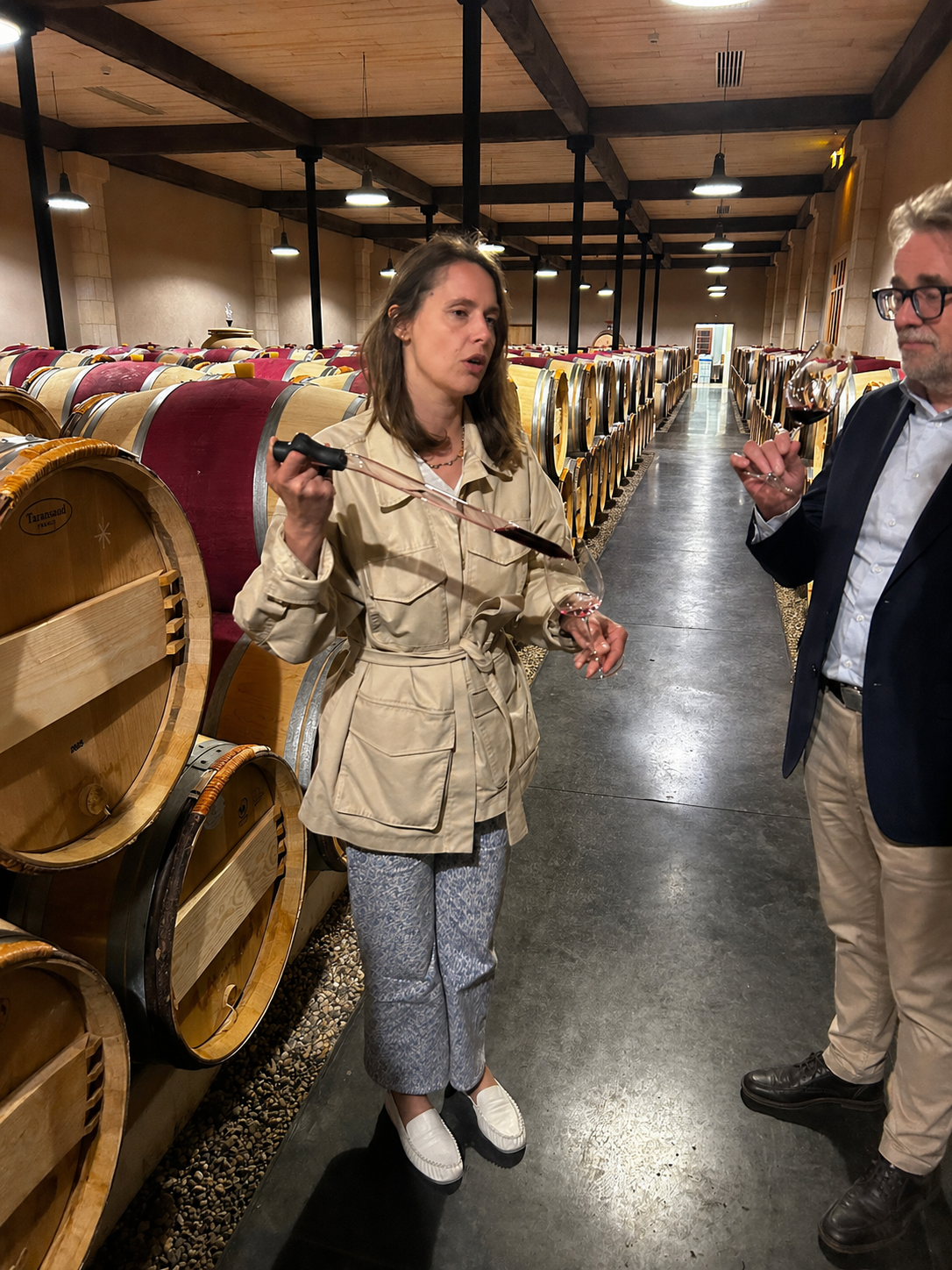
Tasting from a selection of barrels at Chanel-owned Château Rauzan Ségla in Margaux
What is already clear is that the best 2025s combine concentration with freshness, and power with definition. They are not heavy wines. Nor are they merely ripe and polished. There is a tensile quality to many of them: firm tannins, elegant fruit, aromatic lift and a sense of energy beneath the structure. If 2020, 2022 and 2023 often impressed through clarity and approachability, 2025 seems likely to appeal to those who value more old-fashioned claret virtues: architecture, restraint, persistence and the promise of long life.
Perhaps “old-fashioned” is not quite the right word. The precision of viticulture and winemaking today means that these are not austere wines in the old sense. The fruit is clean, the tannins are better managed, and the best estates have avoided excess. The recent solar vintages we mentioned have sometimes been referred as modern classics. For that reason, the term post-modern springs to mind for 2025: classical in structure, but very contemporary in its purity, elegance, and polish.
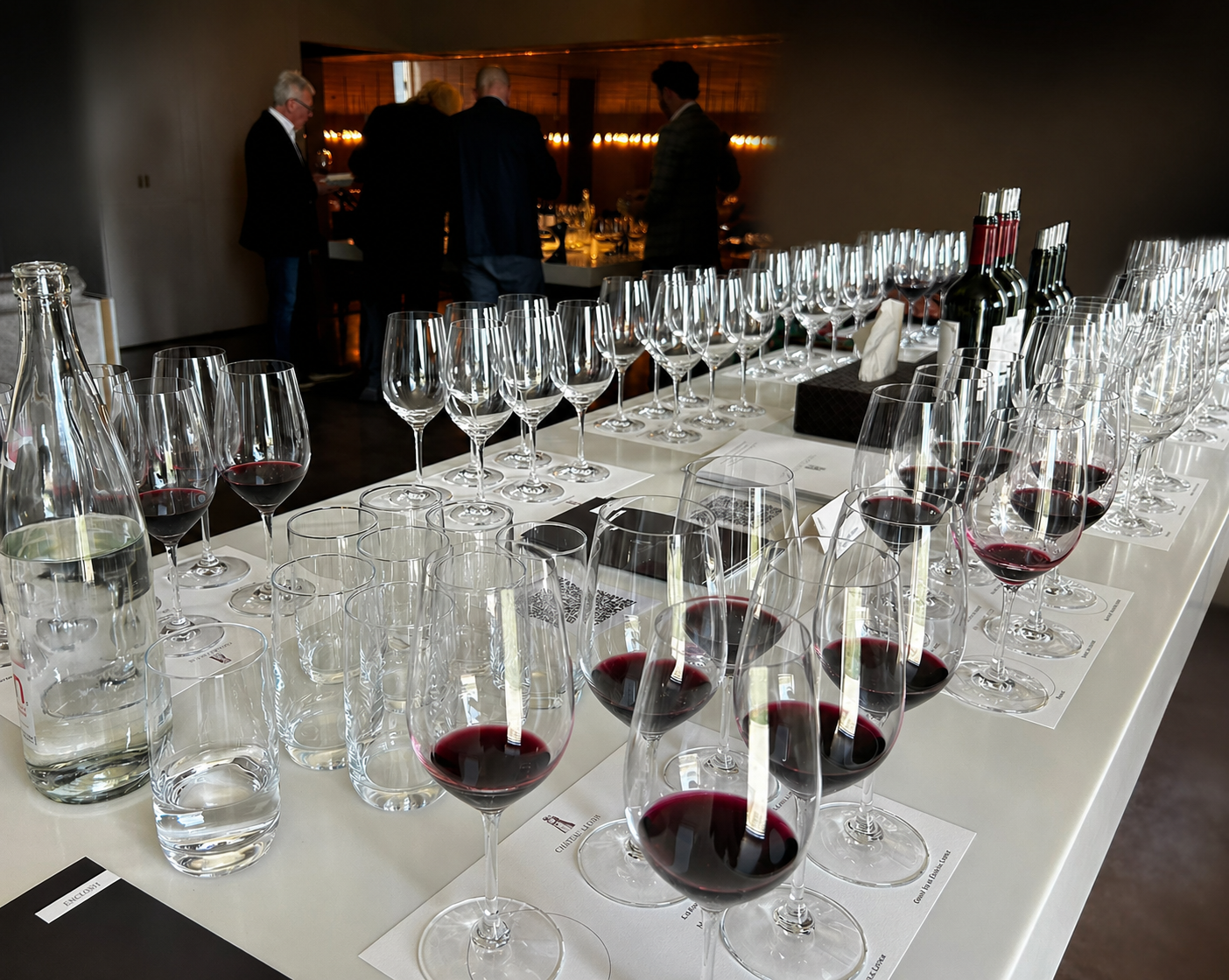
Château Latour showed their 2025 vintage wines alongside their current releases, Latour 2019 and Les Forts de Latour 2020
Yields are an important part of the story. The crop was much reduced, in many cases around half a normal harvest. This follows another small vintage in 2024 and sits within a wider contraction in Bordeaux production. The region is producing far less wine than it did a generation ago, with fewer growers, fewer hectares under vine, and sharply reduced volumes in many communes. Much of that reduction has affected lower-quality commercial production, but even the great appellations are not immune. The best wines of 2025 may therefore be both sought after and relatively limited.
Among the highlights of our tastings were Montrose, Grand Puy Lacoste, Vieux Château Certan and Lafite; an unbelievably good Léoville Barton, and a block-busting Pontet-Canet. From the more affordable wines, Cantemerle stood out, and there were also encouraging performances among the cru bourgeois, including a sumptuous, crowd-pleasing Beaumont.
Our impression is that 2025 has potential to be considered as one of the greats: Ripe, but not overblown, structured but not hard, concentrated yet fresh. It does not simply repeat the style of the recent great warm vintages. Instead, it offers something different: a return to serious, ageworthy Bordeaux, but with the added precision and purity of modern winemaking.
En primeur releases will begin shortly, and quantities are likely to be limited. Please do contact us with your advance expressions of interest, particularly for the leading châteaux and any wines you would like us to watch closely on your behalf.
Visit our 2025 Bordeaux En Primeur Offers page.
THE 2025 GROWING SEASON
The growing season began very early. A mild winter encouraged budbreak well ahead of the norm, and flowering was both early and notably even. From there, the growing cycle continued at speed, ultimately leading to one of the earliest harvests in recent years. Summer heat then became the defining feature. June was exceptionally warm, while August brought repeated spikes above 35°C, with some vineyards recording extreme highs. Rainfall was limited for much of the season, and drought became severe in certain sectors, especially on free-draining gravel and sandy soils. By contrast, clay-limestone terroirs appear to have coped particularly well.
Happily, rain arrived at a crucial moment towards the end of August and into September, relieving hydric stress and allowing for a steady ripening period. This appears to have helped preserve moderate alcohol levels, as well as the freshness and balance now being noted in the wines. Another advantage of the dry conditions was very low disease pressure, with far less mildew than in recent vintages and little frost damage to speak of.
The principal issue in 2025 is quantity. Yields are expected to be significantly down across Bordeaux, with many estates reporting very small crops. That will present economic challenges, but it also helps in explaining the concentration and intensity seen in the best early samples.
The preceding vintage was also much reduced in size, and in his excellent and informative annual vintage report for Jancisrobinson.com, Gavin Quinney points out the wider trend in the region, with fewer than 300 million litres of Bordeaux produced in the last two vintages, compared with an average of 650 million litres per year in the late '90s.
The number of producers and the area of vines has also fallen drastically. For many years, when talking about Bordeaux, we have confidently said 'there are over 14,000 individual producers', but reading Quinney's report, we were shocked to find this has fallen to around 5,000. 20,000 hectares of vines have been grubbed up over the last two decades, equivalent to about two thirds of the area of the Côte d'Or! Much of this is accounted for by reductions in low-quality commercial wines, but Quinney also shows how yields across many of the top communes are down on their 20-year averages: 37% in St-Julien, 21% for Pomerol, 29% for Margaux, and 27% in Pauillac. To emphasise the point, he says:
"It’s extraordinary to think that for the excellent 2016 harvest, Bordeaux produced twice as much wine as it did in 2025." - Gavin Quinney, Bordeaux 2025 weather and crop report, for Jancisrobinson.com, Apr '25
VIEW OUR FULL LIST OF RELEASED WINES BELOW. YOU CAN ALSO VIEW OUR PRE-RELEASE AND RELEASE OFFERS HERE, WITH MORE DETAILS ON EACH CHATEAU.
| RED | 2025 | Château Angelus | 75cl | £1,200 per case of 6 | Château Angelus 2025 / / 75cl £1,200 per case of 6 |
IB | |||||
Tasting Notes"The 2025 Angélus was picked from September 10 to 20 and Stéphanie de Bouard told me that they halved the pumpovers. The Cabernet Franc is aged half in foudres and half in new barrel, and the Merlot is half in new barrel and half in one-year-old barrels that were used for the 2023 vintage. The alcohol is 14.05% with a pH of 3.6, many grapes showing a gram or more malic acid. This note comes from a narrower Riedel glass that showed the wine in a better and more accurate light. The bouquet opens with blackberry, raspberry, light cassis scents and a touch of iodine, well defined, the oak seated politely in the background. The palate is silky smooth with filigree tannins, very well judged acidity plus palpable underlying sapid notes that come through towards the finish. Fine tension, very focused with a very persistent aftertaste, this is an Angélus with great potential and it should give 25 to 30 years' drinking pleasure. Drink: 2033 - 2060. 95-97 points" Neal Martin, Vinous.com------"The depths are immediately apparent, clear polished stones, liquorice root, olive pit, espresso, cappuccino, full of the luscious signature of the estate, clutches of sage and freshly cut herbs, savoury with a pumice stone climb through the palate. Benjamin Laforêt technical director. Harvest September 10 to 20, 30hl/ha yield, 3.65ph. The Boüard-owned Château Bellevue plots have been included in here as of 2022, ad you can imagine that this vintage really benefited from its limestone soils. As of 2026 vintage Angelus will be made in the new cellar. 2034-2048. 97 points" janeanson.com------"The 2025 Angélus (50% Cabernet Franc, 50% Merlot) is a superb contemporary Grand Vin. Aromatic, vibrant and wonderfully fresh, the 2025 dazzles from start to finish. Blood orange, mint, white pepper, rose petal and chalk weave through layers of vibrant red-toned fruit. Here, too, the Grand Vin impresses with its noble purity and understated grace. Élevage is 50% foudre/50% new oak for the Cabernet Franc, and 60% new oak/40% once-filled barrels for the Merlot. I can't wait to see how this ages. 2035-2065. 95-97+ points" Antonio Galloni, Vinous.com------"Cassis, graphite, violets, iris, and a wonderful sense of minerality all define the 2025 Château Angélus, another ultra-classic Saint-Emilion from this address. It's a 50/50 blend of Cabernet Franc and Merlot, with the Merlot raised in 60% new oak and 40% once-used oak and the Cabernet Franc split between 50% new oak and 50% foudre. Checking in at 14% alcohol with a pH of 3.6, it's medium to full-bodied on the palate, with incredible purity, classy background oak, integrated acidity, and a great finish. 96-98 points" Jebdunnuck.com------"A blend of equal parts Cabernet Franc and Merlot, the 2025 Angélus is already beautifully harmonious, even at this early stage. Unfurling in the glass with notes of sweet dark berries and plums mingled with notions of violets, licorice and spices, it's medium- to full-bodied, layered and multidimensional, with ripe tannins, lively acids and a long, perfumed finish. Much like its 2022 predecessor, the 2025 underlines that this estate's shift toward greater purity and subtler élevage choices can be sustained even in historically warm years. 96-98 points" William Kelley, RobertParker.com------"The pureness of fruit is exceptional, with a long and linear palate of wonderfully curated raspberry, cherry and blueberry aromas and flavors. Medium-bodied. You almost don’t see the tannins, but you know they are there. So silky and endless. It has the core of fruit of the best of the vintage. 50% merlot and 50% cabernet franc. 99-100 points" jamessuckling.com |
|||||||||||
| RED | 2025 | Château Angludet | 75cl | £242 per case of 12 | Château Angludet 2025 / / 75cl £242 per case of 12 |
IB | |||||
Tasting NotesAn appealing and open nose, of fresh blackberries, leaden to even richer black fruit on the palate, principally blackcurrant and cherry, along with notes of violets and pencil lead. This vintage has more structure than recent years, with very ripe, supple tannin and a medium-weight body, sure to develop into a very classical Margaux. The most appealing and impressive vintage since the phenomenal 2016. RKL------"Deep colour. Already expressive with dark-fruit and spicy notes. Palate full flavoured, the fruit generous, the tannins fine and integrated. Some persistence on the finish. Should be a good buy for the drinking consumer. 16.5 points" jancisrobinson.com (JL)------"Deep and juicy, intense, with gunsmoke reducton on the opening, and sappy tannins that hold clear ageing potential. 91 points" janeanson.com------"Quite striking aromatics with dark fragrance and herbal aspects plus blackcurrant and dried herbs. Supple and juicy, subtle with a lovely softness here – almost creamy strawberry with a perfumed fragrance lingering on the palate before turning more grippy and saline towards the finish with liquorice, flint and wet stone. It’s a fine Angludet with power and structure but there’s purity and focus and such a clean finish. 3.78pH. A yield of 23hl/ha. No deleafing. Ageing 35% amphoras, 65% barrels (30% new oak). 94 points" Georgina Hindle, Decanter Magazine |
|||||||||||
| RED | 2025 | Château Angludet | Magnum | £260 per case of 6 | Château Angludet 2025 / / Magnum £260 per case of 6 |
IB | |||||
Tasting NotesAn appealing and open nose, of fresh blackberries, leaden to even richer black fruit on the palate, principally blackcurrant and cherry, along with notes of violets and pencil lead. This vintage has more structure than recent years, with very ripe, supple tannin and a medium-weight body, sure to develop into a very classical Margaux. The most appealing and impressive vintage since the phenomenal 2016. RKL------"Deep colour. Already expressive with dark-fruit and spicy notes. Palate full flavoured, the fruit generous, the tannins fine and integrated. Some persistence on the finish. Should be a good buy for the drinking consumer. 16.5 points" jancisrobinson.com (JL)------"Deep and juicy, intense, with gunsmoke reducton on the opening, and sappy tannins that hold clear ageing potential. 91 points" janeanson.com------"Quite striking aromatics with dark fragrance and herbal aspects plus blackcurrant and dried herbs. Supple and juicy, subtle with a lovely softness here – almost creamy strawberry with a perfumed fragrance lingering on the palate before turning more grippy and saline towards the finish with liquorice, flint and wet stone. It’s a fine Angludet with power and structure but there’s purity and focus and such a clean finish. 3.78pH. A yield of 23hl/ha. No deleafing. Ageing 35% amphoras, 65% barrels (30% new oak). 94 points" Georgina Hindle, Decanter Magazine |
|||||||||||
| RED | 2025 | Château Angludet | Half bottle | £280 per case of 24 | Château Angludet 2025 / / Half bottle £280 per case of 24 |
IB | |||||
Tasting NotesAn appealing and open nose, of fresh blackberries, leaden to even richer black fruit on the palate, principally blackcurrant and cherry, along with notes of violets and pencil lead. This vintage has more structure than recent years, with very ripe, supple tannin and a medium-weight body, sure to develop into a very classical Margaux. The most appealing and impressive vintage since the phenomenal 2016. RKL------"Deep colour. Already expressive with dark-fruit and spicy notes. Palate full flavoured, the fruit generous, the tannins fine and integrated. Some persistence on the finish. Should be a good buy for the drinking consumer. 16.5 points" jancisrobinson.com (JL)------"Deep and juicy, intense, with gunsmoke reducton on the opening, and sappy tannins that hold clear ageing potential. 91 points" janeanson.com------"Quite striking aromatics with dark fragrance and herbal aspects plus blackcurrant and dried herbs. Supple and juicy, subtle with a lovely softness here – almost creamy strawberry with a perfumed fragrance lingering on the palate before turning more grippy and saline towards the finish with liquorice, flint and wet stone. It’s a fine Angludet with power and structure but there’s purity and focus and such a clean finish. 3.78pH. A yield of 23hl/ha. No deleafing. Ageing 35% amphoras, 65% barrels (30% new oak). 94 points" Georgina Hindle, Decanter Magazine |
|||||||||||
| RED | 2025 | Château Ausone | 75cl | £2,172 per case of 6 | Château Ausone 2025 / / 75cl £2,172 per case of 6 |
IB | |||||
Tasting Notes"The 2025 Ausone is powerful, dense and packed to the core. Readers will have to be patient with the 2025, as it is quite reticent. In 2025, the Vauthier family did not produce a second wine at Ausone. Consequently, the blend in the Grand Vin is a bit different than in most years, at 65% Cabernet Franc, 30% Merlot and 5% Cabernet Sauvignon. Time in the glass brings out hints of blood orange, rose petal, mint and raspberry jam. It will be fascinating to see how the 2025 ages. 2035-2075. 95-97 points" Antonio Galloni, Vinous.com------"Nuanced layers of rose petals and iris flowers, knitted down, textural and expansive, will take its sweet time to uncoil and uncurl, but you can see exactly how rewarding it will be to follow its journey. A stunning example of Ausone. Harvest September 2 to 23. No Chapelle. 30hl/h yield, 3.5ph, 100% new oak. 2034-2050. 97 points" janeanson.com------"Checking in as a blend of 65% Cabernet Franc, 30% Merlot, and 5% Cabernet Sauvignon from 7.25 hectares of vines on a limestone hillside just outside the village of Saint-Emilion, the 2025 Château Ausone will spend 20 months in new barrels. The Merlot was harvested September 2-12, the Cabernet Franc September 15-18, and the Cabernet Sauvignon on the 18th, from yields of 30 hectoliters per hectare. It's a very classic expression from this château, with ripe black cherries, graphite, classy oak, liquid violets, and chalky minerality on the nose. On the palate, it's rich and medium to full-bodied, with a straight, focused, beautifully concentrated mouthfeel, plenty of chalky tannins, and a great finish. As with most Ausone, the cellar is going to be your friend. 95-97+ points" jebdunnock.com------"The 2025 Ausone represents the entirety of the vineyard this year after trial blends convinced the Vauthiers not to make a Chapelle d’Ausone. There is also 5% Cabernet Sauvignon in the blend for the first time, from five tiny plots located on a terrace close to the quarry, so that heat reflects off the wall to ensure ripening. It was picked between September 2 and 23. Almost immediately, I noticed how that soupçon of Cabernet Sauvignon tilts the style of the Grand Vin in a different and, to my mind, positive direction. Beautifully defined, a little more sapid, perhaps just a tad less precocious than usual, there is a sense of classicism in this Ausone that I admire, terroir over growing season perhaps? The palate is medium-bodied with pliant tannins, real depth, silky smooth, with layers of blackberry and raspberry fruit and hints of white pepper and clove. Very long, with a peacock's tail on the finish, this is a fascinating and alluring Ausone that will age with style. Drink: 2035 - 2065. 96-98 points" Neal Martin, Vinous.com------"A blend of 65% Cabernet Franc, 30% Merlot and 5% Cabernet Sauvignon, the 2025 Château Ausone unwinds in the glass with notes of sweet raspberries and mulberries mingled with notions of mint, rose petals and blood orange. Medium- to full-bodied, lively and perfumed, with lovely energy, exquisitely refined tannins and a bright, precise finish, it shows extraordinary potential. Some discreet changes are underway at this address, with picking (between September 2 and 23) broken up plot by plot to a greater degree; a review of the estate's cooperage choices in pursuit of better integration; and, at least this year, no second wine for the first time since 1994—given the quality of Ausone's terroir and vine material, that seems entirely reasonable. The result is one of the most refined, classy Ausone vintages in recent years, and it will be exciting to follow these evolutions over the years to come. 97-99 points" William Kelley, RobertParker.com------"A high-definition wine. Wow. The aromas are incredible, with roses, strawberries and crushed stones. So perfumed. It’s the magic of perfectly ripe cabernet franc. Medium-bodied with ultra-fine tannins and a firm and silky finish. Sublime length and mouthfeel. Cool, subtle, sophisticated and stunning. So much definition. 13.7% alcohol. A blend of 65% cabernet franc, 30% merlot and 5% cabernet sauvignon. 99-100 points" jamessuckling.com |
|||||||||||
| RED | 2025 | Château Beaumont | 75cl | £110 per case of 12 | Château Beaumont 2025 / / 75cl £110 per case of 12 |
IB | |||||
Tasting Notes"62% Cabernet Sauvignon, 34% Merlot, 4% Petit Verdot. 27 hl/ha. Cask sample.N Dark and perfumed with a hint of vanilla oak. Palate juicy and supple, the tannins not aggressive. Already quite approachable but structured all the same. 16 points" jancisrobinson.com (JL)------"The 2025 Beaumont is a potent, burly Haut-Médoc Cru Bourgeois. Dark red-toned fruit, gravel, incense, dried herbs and incense are front and center. There's a bit of toughness in the tannins, but that's not too surprising at this level. This Haut-Médoc will be a fine companion at the dinner table, especially if enjoyed with similarly hearty fare. 88-90 points" Antonio Galloni, Vinous.com------"Checking in as a blend of 62% Cabernet Sauvignon, 34% Merlot, and 4% Petit Verdot that's still resting in 30% new barrels, the 2025 Château Beaumont is a clear step up over the previous vintage in richness, texture, and depth. The nose shows lots of ripe darker red and almost blue fruits alongside classic tobacco and damp earth notes that take on an almost Saint-Estèphe-like character. On the palate, it's medium-bodied with ample mid-palate depth, ripe tannins, and a great finish. It checks in as 12.87% alcohol with a pH of 3.76. Tasted twice. 89-91 points" jebdunnock.com------"The consistency and impressive quality of Beaumont is again in evidence, slate, cocoa bean, dark chocolate, a slate drag through the palate exactly as you want, delivering estate signature, ageing potential but above all a mouthwatering drinkabilty. Harvest 3 to 17 September, yield 27 hl/ha. 91 points" janeanson.com------"Liquorice and black chocolate notes on the nose with juicy blackcurrant aromas. A combination of slightly sweet, ripe black fruit with cool, saline aspects. Touches of wood come in where there’s not so much flesh right now, but there’s a nice line of freshness and bright acidity and push from start to finish. A little lean and spicy on the finish but it’ll soften. Will be good to drink early. 3.75pH. A yield of 26hl/ha. Harvest started 3rd September. Drinking Window: 2028 - 2036. 91 points" Georgina Hindle, Decanter Magazine------"The 2025 Beaumont was cropped at just 25 hl/ha. It has a very lifted and perfumed, fruity nose that oddly reminds me of a low SOQ wine, and I don't mean that negatively (noted on second and third sample bottles). There is very attractive purity. The palate is medium-bodied with fine but firm tannins, well-judged acidity and a light patina of new oak that will be absorbed with time. Very "pencil box", almost Pauillac-like on the finish. A couple of years in bottle and you will have a fine Beaumont on your hands. Lovely length on the aftertaste too! Just 12.9% alcohol. 2031-2049. 90-92 points." Neal Martin, Vinous, May '26 |
|||||||||||
| RED | 2025 | Château Beausejour Becot | 75cl | £270 per case of 6 | Château Beausejour Becot 2025 / / 75cl £270 per case of 6 |
IB | |||||
Tasting Notes"The 2025 Beau-Séjour Bécot was picked from September 5 to 12 for the Merlot and September 17 and 18 for the Cabernet Franc, which represents 20% of the blend due to new plantings that are reorientated north-south instead of east-west. Proprietor Juliette Bécot told me that yields were 32 hl/ha, mainly due to the initiation florale; they conducted a long 15-day cold maceration and used 50% new barrels, 37% Foudres and the remainder in used barrel and amphora, malo done in vat. The nose takes a few minutes to open in the glass. Mineral-rich black and red fruit, clearly limestone-driven, touches of graphite and briny scents emerge with time. The palate is medium-bodied with sapid red fruit, mainly raspberry with some white-tipped strawberry. Like others, the limestone really comes through in this wine that could almost be described as "rocky". Linear and correct on the finish, again, it will gain more flesh during its barrel maturation and it will become an extremely fine and classy Saint-Émilion. 13.4% alcohol. Drink 2032 - 2058. 94-96 points" Neal Martin, Vinous.com------"A medium-bodied red with a very salty and bright character and a lovely, silky texture. It’s round, polished and intense. Superb finish of mineral and iron undertones. Racy and refined. A unique wine with a texture like a great Burgundy. 80% merlot and 20% cabernet franc. 97-98 points" jamessuckling.com------"The 2025 Beau-Séjour Bécot continues this estate's brilliant run of vintages with what will surely number among their finest to date. A blend of 80% Merlot and 20% Cabernet Franc, this compelling wine opens in the glass with a pure and incipiently complex bouquet of dark berries and plums mingled with floral accents of iris and lilac. Medium- to full-bodied, deep and layered, with a concentrated core of fruit, sweet tannin and a bright spine of animating acidity, it concludes with a long, mineral finish. Beau-Séjour Bécot's limestone terroir is front and center in the glass. 97-99 points" William Kelley, RobertParker.com------"The 2025 Beau-Séjour Bécot has all the requisites to take its place alongside the 2022 and the other extraordinary wines of 2025. Aromatic and layered, with striking presence, the 2025 is majestic. Deep, dark red fruit, pomegranate, mint, chalk, white pepper, rose petal and lavender soar from the glass. Bright saline notes drive through the mid-palate and into a finish marked by intense fruit and vibrant minerality. The purity here is just off the charts. Yields were 32 hectoliters per hectare. The 2025 saw a cold soak of 15 days followed by another 27 days or so on the skins, on the longer side for Bordeaux. Blending is done before the wines see oak. There are good wines, exceptional wines, and then emotional wines. Beau-Séjour Bécot falls into the third category. Unforgettable. Tasted two times. 2033-2065. 98-100 points" Antonio Galloni, Vinous.com |
|||||||||||
| RED | 2025 | Château Beychevelle | 75cl | £377 per case of 6 | Château Beychevelle 2025 / / 75cl £377 per case of 6 |
IB | |||||
Tasting Notes"The 2025 Beychevelle reveals a toasty, oak-marked bouquet of dark wild berries, licorice and spice. Medium- to full-bodied, structured and concentrated, it’s built around an assertive tannic frame, concluding with a long, spicy, licorice-inflected finish. While the wine is marked by both concentration and oak at this stage, élevage may bring greater finesse and a more integrated, enveloping tannic profile. 92-93 points". Yohan Castaing, Wine Advocate, April 2026------"Cloves and grilled red peppers, deep mulberry fruits, this is so delicious, charcoal and liquorice, St Julien balance, really luscious and joyful. Yield 32 hl/ha. Philippe Blanc director. 2034-2044. 93 points. Jane Anson, JaneAnson.com, April 2026------"Such a gorgeous fragrance on the nose, so alive, so floral and expressive with milk chocolate, cherries and violets. Grippy and alive in the mouth, fun, bright, certainly full of tannins and grip with a lovely core of black bramble fruit with straight acidity. I like the very hands-off nature, it’s refined and finessed, still young and a little shy but lots of tannins are so well handled by the fruit purity and acidity. It’s a big, powerful, muscular wine but so poised, mouthwatering and charming. It has a spiced kick on the finish which adds to the complexity. 3.6pH. 80 IPT. 13% press wine. 60% of production. Reduced maceration by 5-7 days. Ageing 70% new oak. 2030-2044. 94 points." (GH) Decanter, Apr '26------"Spicy, with dark fruit aromas. Angular in style, with a linear profile and precise, focused tannins. It shows clarity, fresh dark fruit and balance that stands out. 95-96 points." James Suckling, JamesSuckling.com, April 2026------"The 2025 Beychevelle is a very sexy wine. Plush and exuberant, the 2025 is seriously impressive right out of the gate. Blackberry, lavender, mocha, crème de cassis and a kick of French oak are all beautifully amplified in the glass. The blend is 52% Cabernet Sauvignon, 43% Merlot and 5% Petit Verdot, with the plush richness of the Merlot very much in evidence. There's a lot of wine here. The 2025 spent three weeks on the skins, more or less the norm here, but it also includes 13% press wine, a bit higher than most years. More than anything else, the 2025 is a wine of extreme pleasure. It is an exceptional Beychevelle, one of the finest in recent memory. 2035-2075. 95-97 points". Antonio Galloni, vinous.com, April 2026------"The 2025 Beychevelle was picked from September 5 to 21 at 31 hl/ha, fairly reasonable for Saint-Julien this year, albeit the second lowest after 2013. Matured in 70% new oak, this has a concentrated nose with blackcurrants, blueberry, inkwell and light violet scents. Very fine definition, a Beychevelle that leans on the more opulent side aromatically, though always controlled. The palate is medium-bodied with a velvety smooth entry that lends it sensuality. Extremely precise, exquisite pure fruit, quite mineral-driven with a very long, quite sensual finish. I don't think Philippe Blanc has overseen a Beychevelle as good as this. 13.4% alcohol. Drinking Window 2032 - 2060. 95-97 points". Neal Martin, vinous.com, May 2026------"A brilliant, deeply hued wine, the 2025 Château Beychevelle is based on 52% Cabernet Sauvignon, 43% Merlot, and 5% Petit Verdot, and is still resting in 70% new oak. One of the earliest harvests ever recorded at this château, with very tiny yields, it has a ripe, sexy, gorgeously textured style with ripe black cherries, graphite, spicy wood, and dried flowers on the nose. On the palate, it's medium to full-bodied, with a round, layered mouthfeel, velvety tannins, and a blockbuster finish. Hitting 13.5% alcohol with a pH of 3.6, this is a ripe, expressive Beychevelle that will evolve gracefully for 30 years or more. Tasted twice with consistent notes. 96-98 points" jebdunnock.com |
|||||||||||
| RED | 2025 | Château Branaire Ducru | 75cl | £186 per case of 6 | Château Branaire Ducru 2025 / / 75cl £186 per case of 6 |
IB | |||||
Tasting Notes"Intense, knitted down with grilled cumin and cloves, sappy dark fruits, appellation typicity, an enjoyable enjoyable Brainaire. Yield 33 hl/ha. 60% new oak, François Xavier Maroteaux owner. 2034-2044. 93 points" janeanson.com------"The 2025 Branaire-Ducru was cropped at 33 hl/ha, which is not too low in the context of the growing season, but the smallest since 1991. Picking was from September 4 with the early Merlots and finished September 22. The Merlot on clay soils was deemed high quality and therefore comprises a slightly higher percentage of the blend. It is aged in 60% new and 40% one-year-old barrels. This has a flattering bouquet with black plum and strawberry fruit, and a noticeable though agreeable powdered chocolate/mocha note at the moment. The palate is medium-bodied with silky smooth tannins, a fine bead of acidity, and hints of mocha and mint merging with black fruit. The finish is quite linear and understated, keeping within the style of the château. Very classy, this will give a lot of pleasure without too much cellaring. 13.2% alcohol. Drinking Window 2030 - 2055. 93-95 points" Neal Martin, Vinous.com------"The 2025 Branaire-Ducru is a compelling wine in the making, revealing an open, refined bouquet of cassis, mulberries, spices, flowers and pencil lead, with its new oak largely remaining in the background. Medium- to full-bodied, it’s sapid and perfumed, built around a seamless, layered core of fruit framed by finely grained, velvety tannins and concluding with a long, fresh and precise finish. Matured in 65% new oak, this blend of 62% Cabernet Sauvignon, 26% Merlot, 6% Petit Verdot and 6% Cabernet Franc captures the estate’s signature style—polished, balanced and texturally refined—while clearly reflecting the brightness and freshness of the vintage. 94-96 points" Yohan Castaing, RobertParker.com------"The 2025 Branaire-Ducru is a powerful wine with a darker fruit profile than most years. Dark blue/purplish fruit, lavender, cloves and licorice open first. Floral overtones and brisk acids reappear to perk up the close. A clean, vibrant finish rounds things out in style. This is such a gorgeous and expressive wine. The 2025 is quite simply a fabulous Branaire. Tasted two times. 2035-2065. 94-96 points" Antonio Galloni, Vinous.com------"Voluptuous dark fruit, cedar and a touch of tar on the nose. Medium- to full-bodied with an expressive yet concentrated profile, a precise structure and fine-grained, high quality tannins. Chiseled and balanced. 96-97 points" jamessuckling.com |
|||||||||||
| RED | 2025 | Château Brane Cantenac | 75cl | £237 per case of 6 | Château Brane Cantenac 2025 / / 75cl £237 per case of 6 |
IB | |||||
Tasting Notes"A blend of 80% Cabernet Sauvignon, 18% Merlot, 1% Cabernet Franc and 1% Carmenère (the latter harvested by the winery team after everything else has been picked), the 2025 Brane-Cantenac offers up a rich bouquet of crème de cassis, plums and spices, framed by a deft touch of new oak. Medium- to full-bodied, layered and lively, with powdery tannins that contribute youthful grip on the finish, it checks in at a very classical 13.3% alcohol and pH of 3.62. 93-96 points." William Kelley, Wine Advocate, April 2026------"The 2025 Brane-Cantenac was picked from September 2 to 29, finishing with that 1% of late-ripening Carménère, cropped at 32.2 hl/ha. It has impressive purity on the nose, an aspect of the Grand Vin that Henri Lurton and his team have improved immensely over the last decade. Black cherries, bilberry, violet and crushed stone unfold in the glass, classical in style, which is Brane-Cantenac's signature. The palate is medium-bodied with supple, finely sculpted tannins allied with disarming sapidity and brightness. Not powerful like the 2022, yet pixelated with a mineral, tensile, complex finish. Another feather in the cap for Lurton and, moreover, this is often one of the best values on release.Window 2032-2060. 95-97 points." Neal Martin, vinous.com, May 2026------"A medium-bodied and solid red with blackberry, chocolate, meat and walnut character. It shows juicy tannins and a long finish. Persistent and classy. Such length and balance. 96-97 points." James Suckling, JamesSuckling.com, April 2026------"The 2025 Brane-Cantenac is incredibly polished right out of the gate. Floral overtones lead into a core of blue/purplish fruit, spice, new leather, tobacco, lavender and a kiss of French oak. Silky tannins lend shape and finesse. The aromatics alone are so compelling, but everything about the 2025 speaks to balance. It’s a magnificent effort from proprietor Henri Lurton and his team. One of the highlights of the vintage. 2035-2065. 95-97 points." Antonio Galloni, vinous.com, April 2026------"This is luscious and full of wonderfully bright fruits, great concentration, cushion of air underneath, high Cabernet and it comes through in the floral aromatics, clearly a plentiful tannic structure but luscious and layered damson and black cherry. Yes yes yes. 12.10% press wine. 3.62 pH. Tasted twice. 100 years of the Lurtons at Brane. 2036-2055. 97 points." Jane Anson, JaneAnson.com, April 2026------"Cassis, graphite, liquid violets, and tobacco all define the 2025 Château Brane-Cantenac, a blend of 77% Cabernet Sauvignon, 20% Merlot, and 1% each Cabernet Franc, Carménère, and Petit Verdot that's being raised in 100% new French oak. On the palate, it's medium to full-bodied, with a focused, elegant mouthfeel, beautiful concentration and depth, integrated acidity, and a great finish. Hitting 13.5% alcohol, it's a brilliant success in the vintage and should be snatched up by readers. 96-98 points." Jeb Dunnuck, Apr '26 |
|||||||||||
| RED | 2025 | Château Calon Ségur | 75cl | £399 per case of 6 | Château Calon Ségur 2025 / / 75cl £399 per case of 6 |
IB | |||||
Tasting Notes"Aromas of ripe black currants, yet menthol and other fresh herbs come through. Medium body, with firm and slightly chewy tannins and a savory finish. Plenty going on here. 80% cabernet sauvignon, 17% merlot, 2% cabernet franc and 1% petit verdot. 95-96 points." James Suckling, Apr '26------The 2025 Calon Ségur is a total head-turner. Aromatic and structured, the 2025 hits all the right notes. Readers will have to be patient, as the 2025 is packed with intense fruit and equally potent tannins that will need a decade to soften. This is a big, big wine. Here, too, the aromatics are so present, with lingering notes of dried herb, crushed rose petal and mint. 2035-2065. 95-97 points." Antonio Galloni, vinous.com, Apr '26------A blend of 57% Cabernet Sauvignon, 34% Merlot, 7% Cabernet Franc and 2% Petit Verdot, the 2025 Calon-Ségur offers up a deep and incipiently complex bouquet of dark berries, rose petals and violets, framed by a deft touch of new oak. Full-bodied, deep and layered, with terrific energy, abundant but ultra refined tannins and a long, penetrating finish, it checks in at a very classically proportioned 13.6% alcohol and pH of 3.6. 95-97 points." William Kelley, Wine Advocate, Apr '26------"The 2025 Calon Ségur contains just a little more Merlot this year at 17%, though it is still dominated by the 80% Cabernet Sauvignon, picked between September 4 and 20 over 15 days at 35 hl/ha. It represents 65% of the estate's total production this year. As usual, this is matured entirely in new French oak for a planned 20 months. This has immense clarity and precision on the nose, blackberry and cedar, a little sous-bois, beautifully delineated and more elegant than some recent vintages. The new wood is folded in and barely noticeable even at this early juncture. The palate is medium-bodied with grippy, slightly chalky tannins on the entry. There is quite a conspicuous marine/estuarine element with hints of Japanese nori infusing the black fruit, almost briny in style…I like that. It gives this Calon personality and bandwidth. Classical in style and lower alcohol at 13.6% compared with recent releases (the 2022 was 14.5%), this has a very promising future. Drinking Window 2032 - 2060. 95-97 points." Neal Martin, vinous.com, May '26------"The most firmly constructed wine of the Calon stable of course, but it still delivers the combination of finesse and concentration that is typical of the best wines in 2025. Much more graphite and slate on the texture of this main wine, this is one of the wines that really showcases the highest potential of the vintage, and it is an exceptional Calon. So layered, iris bud, cassis, crushed violet flowers, espresso and cocoa bean. A slow unroll. 100% new oak. 3.6 pH. Yield 35 hl/ha, Harvest September 4 to 20. 2034-2048. 98 points." Jane Anson, Apr '26 |
|||||||||||
| RED | 2025 | Château Canon | 75cl | £435 per case of 6 | Château Canon 2025 / / 75cl £435 per case of 6 |
IB | |||||
Tasting Notes"An impressive Canon, seductive limestone character that showcases what was possible in the vintage. Slate, chalk and pumice stone, all wrapped up in bright and vivid iris flowers, push and pull momentum through the palate where things stop, take a breath, then kick off again with a new layer of nuanced understated toasted spice and cool blue fruits. Deft, skilful, rooted in place. 40hl/h yield. Tasted twice. Nicolas Audebert director. Thomas Duclos consultant. 3.5ph. 2028-2040. 97 points" janeanson.com------"A blend of 76% Merlot and 24% Cabernet Franc, the 2025 Canon continues this property's brilliant decade-long run of exceptional wines. Unwinding in the glass with a complex bouquet of cherries and raspberries mingled with hints of exotic spices, licorice and petals, it's medium- to full-bodied, suave and concentrated, with a bright spine of acidity and a long, penetrating finish. Harvest stretched from August 28 to September 18. 96-98 points" William Kelley, RobertParker.com------"Ripe cherries, graphite, crushed flowers, and assorted blue fruits all define the 2025 Château Canon, another great wine from this team, which checks in at 76% Merlot and 24% Cabernet Franc and will spend 16 to 18 months in 49% new French oak, with the balance in foudre. On the palate, it's medium to full-bodied, with a remarkably polished, flawlessly balanced mouthfeel, ultra-fine tannins, and a great finish. It hits 14% alcohol with a pH of 3.5 and is very much in the ultra-pure, graceful, classic style this terrific château is known for today. Tasted multiple times with consistent notes. Yields here were 40 hectoliters per hectare with harvest running from the 28th of August (one day earlier than 2022) to the 18th of September. 96-98 points" jebdunnock.com------"The 2025 Canon was picked between August 28 and September 18 at 40 hl/ha. This is very pure and refined on the nose, with wonderful delineation, not as flattering as, say, the 2015 or 2019 at this stage, yet very focused and mineral-driven. The palate is medium-bodied with filigree tannins, quite sapid, with a pinch of cracked black pepper. Like its "sister", Berliquet, the limestone terroir comes through and seems to "tingle" on the finish. Maybe not a crowd-pleaser, but I like its uncompromising nature that reflects its place of birth. Drinking Window 2032 - 2055. 96-98 points" Neal Martin, Vinous.com------"The finesse and sophistication are very impressive, with a medium body, ultra-fine tannins and a rather endless finish. It’s medium-bodied ad poised. Great length. A great wine. 98-99 points" jamessuckling.com------"The 2025 Canon is a total stunner. Deep and sumptuous in the glass, it offers tons of the vintage's textural intensity along with all the vibrant, saline energy that is such a signature here. Dark-fleshed fruit, mocha, new leather, herbs and dried flowers build gradually in the glass, leading to a huge, dramatic finish laced with hints of blood orange, pomegranate and chalk. The interplay of finesse and power is dazzling. Tasted two times. 2035-2065. 98-100 points" Antonio Galloni, Vinous.com |
|||||||||||
| RED | 2025 | Château Cantemerle | 75cl | £232 per case of 12 | Château Cantemerle 2025 / / 75cl £232 per case of 12 |
IB | |||||
Tasting Notes"The 2025 Cantemerle is terrific. Plush, deep and quite powerful, Cantemerle has a lot to offer. Dark red fruit, leather, cedar, tobacco and dried herbs are all dialed up. Cabernet Sauvignon drives the blend, which is very much in evidence in the wine's savory intense and structure. There's a lot of wine here. 2030-2043. 91-93 points" Antonio Galloni, Vinous.com------"The 2025 Cantemerle has a pretty nose with violet and iris flower-infused black fruit, very well defined, the oak very well integrated. The palate is medium-bodied with pliant tannins, very well balanced, impressive weight and cohesive, with more precision on the finish than I have noticed on previous vintages of Cantemerle. I appreciate the sapidity here, a moreish Haut-Médoc in the making, and I look forward to revisiting this in bottle. Drinking Window 2031 - 2050. 91-93 points" Neal Martin, Vinous.com------"This shows an attractive nose of flowers and subtle spices from the oak. It has good concentration and a balanced palate, with a clear, expressive fruit profile. 93-94 points" jamessuckling.com------"Captures the austerity that you expect and want during En Primeur, wet stones and graphite, plenty of elegance and balance, measured acidities that give Left Bank typicity, a ton of ageing potential and curls of gunsmoke and flowers. Very pretty, very enjoyable, impressive. Yield 32 hl/ha. 35% new oak. First vintage in new cellars. 2034-2044. 94 points" janeanson.com------"Quite a fragrant, aromatic nose, full of intense violets and irises. The Petit Verdot and the Cabernet Sauvignon really stand out in terms of aromatics. Vivid purple in the glass. Sleek and so svelte, this has such a silky, almost creamy texture, tannins are gorgeous and this has such a juicy, lively core. Nothing out of place here. Super accessible and one of the best primeurs samples for consistency tasted three times. Ends salty with a stony grip. Completed new cellar in July 2024 with 114 vats. The team used a thermal camera for plot-by-plot harvest in 2025. New label as this vintage. 4% Petit Verdot completes the blend. 3.6pH. A yield of 30hl/ha. 60% grand vin production. Ageing 12 months in barrel, 35% new wood. 95 points" Georgina Hindle, Decanter Magazine |
|||||||||||
| RED | 2025 | Château Capbern | 75cl | £174 per case of 12 | Château Capbern 2025 / / 75cl £174 per case of 12 |
IB | |||||
Tasting Notes"The 2025 Capbern is an absolute delight. Bold, juicy and super expressive, the 2025 is so showy today. A rush of dark red-toned fruit, new leather, spice, menthol, dried flowers and mocha makes a strong opening statement. Cabernet Sauvignon drives the blend. Capbern is usually pretty burly. The 2025 offers plenty of fruit intensity along with tannins that are more refined than most years. This is such a gorgeous wine. Best of all, Capbern should be a terrific value. 2028-2040. 90-93 points." Antonio Galloni, vinous.com, Apr '26------"A blend of 62% Cabernet Sauvignon, 36% Merlot and 3% Cabernet Franc, the 2025 Capbern now sports a new label that reflects its historic links to Calon-Ségur. Offering up notes of violets, dark berries and a deft touch of creamy new oak, it's medium- to full-bodied, ample and fleshy, with supple, powdery tannins that assert themselves on the youthfully structured finish. It checks in at 13.8% alcohol. 91-93 points." William Kelley, Wine Advocate, Apr '26------"Beautiful tension and concentration, delivers energy and balance, cassis, bilberry, orange peel, showing the gravel clay limestone terroir, lovely fresh lift, well balanced with finesse. A real drinkability is apparent, helped by wine making choices such as low temperature fermentation, low extraction, low amounts of press wine. Harvest September 4 to 20. New label from 2024 vintage, has the Calon heart and makes explicit the link that the two estates were owned by same family since the 19th century. Vincent Millet director. 60% new oak. 3.60 pH. Yield 32 hl/ha. 2032-2040. 93 points." Jane Anson, Apr '26------"The 2025 Capbern comes with a redesigned label that now sports the same heart-shaped motif in order to visibly link it with Calon-Ségur. This was picked from September 4 with the Merlot until September 20, the fastest harvest ever at 15 days since the maturity was already there. Yields are 32 hl/ha and it was matured in 60% new oak barrels, alcohol 13.8% with a 3.25 pH. This has an attractive bouquet with brambly black fruit, briar, cedar and light tea leaf scents that gradually open in the glass. Fine delineation. The palate is medium-bodied with grainy tannins, gentle grip, a little chalkiness and plenty of freshness and poise towards the finish. More cohesive than recent vintages, I really appreciate the control and minéralité towards the finish. This is one of the best Capbern releases to date. Drinking Window 2031 - 2055. 92-94 points." Neal Martin, vinous.com, May '26 |
|||||||||||
| RED | 2025 | Château Cheval Blanc | 75cl | £2,010 per case of 6 | Château Cheval Blanc 2025 / / 75cl £2,010 per case of 6 |
IB | |||||
Tasting NotesON ALLOCATION "Of all the wines I tasted in the 2025 En Primeur season, this is the one that I have thought about the most. The lowest ever yield at 15hl/ha yield, close to 1961 in terms of volume. There were tiny berries, barely scraping 1g even for the Merlots, even after dropping 10-50% of the grapes even on young vines to minimise water stress. Visually beautiful, deep plum colour, intense, slate, graphite, this has a construction that is clear, muscle, sinew, carved tannins, going long on campfire, chamomile, bitter chocolate, incense, anis, cassis, mint leaf, eucalyptus, crushed rocks, savoury broth. This forces you to project forward - if we are lucky enough to be pulling a bottle out of a cellar in 2060, this Cheval will still be powering along. The honest truth is that I can't tell you with 100% certainly how long it will take to get to its full drinking window. I have not seen a young Cheval with this kind of construction, and I am erring on the side of caution in this note, hoping that it will be more readable in bottle. Stunning and impressive, but I have not yet fallen in love. No Petit Cheval. Harvest September 1 to 18. 3.76ph. Pierre Olivier Clouet director. 2032-2050. 96 points" janeanson.com------"The 2025 Cheval Blanc includes all 47 plots on the estate except one that was sold off. This nose is more immediate than some of its neighbours, a mixture of blackcurrant, raspberry, strawberry and blueberry, very expressive, underneath which lie tobacco and graphite scents. It is open, nothing hidden here. The palate is medium-bodied with sapid red berry fruit, just a touch of black pepper, a more reserved and structured Cheval Blanc than usual, vertical in style, the Cabernet Franc driving the finish. Not what I would call a sensual Cheval Blanc, but it has a distinctive character. Not everyone is going to fall head over heels for this Cheval Blanc because it is uncompromising, and I like that. Just be patient. This will need time. Drinking Window 2033 - 2055. 95-97 points" Neal Martin, Vinous.com------"The 2025 Cheval Blanc is seamless and textured. A wine of mystery and seduction, the 2025 dazzles. Time in the glass brings out the wine's tension and energy. Sage, mint, lavender, cloves and cool, blue-toned fruit all build in the glass. In one tasting, Cheval Blanc was massively tannic; in a second tasting, those tannins were much more seamless, highlighting how differently wines can show from day to day. In the case of Cheval Blanc, en primeur samples are mini-bottlings, and both samples I tasted came from the same batch. Yields in 2025 were just 15 hectoliters per hectare, tiny by any measure. The winemaking team, led by Pierre-Olivier Clouet, used 46 of the 47 parcels on the estate for the Grand Vin. A small amount of wine was sold in bulk; the rest was bottled as Grand Vin. There is no Petit Cheval. Time on skins ran from 26 to 32 days, longer than the 22-28 that's more typical. For those who care about the data, alcohol is just 12.7%, which is hard to believe, with brisk acids that clock in at 3.76 pH. In many vintages Cheval Blanc can be exuberant, but the 2025 is rather closed, more of an intellectual wine that will require years in bottle to truly show everything it has to offer. 2035-2075. 96-99 points" Antonio Galloni, Vinous.com------"Perfumed, with aromas of flowers, brambleberries and wild berries. Medium-bodied with tight, fine tannins that run forever on the palate. Hints of cedar, mushrooms and bark. Crunchy at the end. Just a hint of fancy bitterness and chocolate. Transparent and complete. 97-98 points" jamessuckling.com------"A blend of 51% Merlot, 45% Cabernet Franc and 4% Cabernet Sauvignon, the 2025 Château Cheval Blanc stands out once again as among the finest wines of the vintage in Bordeaux. Wafting from the glass with a deep bouquet of dark berries and cherries mingled with notions of blood orange and iris, it's full-bodied, layered and concentrated, with terrific mid-palate density, sweet tannins and a long, vibrant, violet-inflected finish. With its striking aromas, intensity of flavor and resolutely classical proportions (checking in at 12.7% alcohol and pH of 3.76), the 2025 gives every indication of being one of the great Cheval Blancs of the decade. 98-100 points" William Kelley, RobertParker.com |
|||||||||||
| RED | 2025 | Château Clerc Milon | 75cl | £309 per case of 6 | Château Clerc Milon 2025 / / 75cl £309 per case of 6 |
IB | |||||
Tasting Notes"A balanced, graceful Pauillac, the 2025 Château Clerc Milon is based on 62% Cabernet Sauvignon, 28% Merlot, 8% Cabernet Franc, and the rest Carménère and Petit Verdot, still resting in barrel. Cassis and black cherries, graphite, and a crushed stone-like minerality all define the nose. On the palate, it's medium to full-bodied with a pretty, pure, almost understated profile that builds nicely with time in the glass. It's a beautiful Pauillac in the making, and I'd certainly be happy with bottles in the cellar. 92-94 points." Jeb Dunnuck------"The 2025 Clerc Milon has turned out beautifully, offering up notes of dark berries, petals and orange zest, framed by a deft touch of new oak. Medium- to full-bodied, dense and concentrated, with lively acids and a chalky finish, it's a blend of 62% Cabernet Sauvignon, 28% Merlot, 8% Cabernet Franc and the rest Carmenère and Petit Verdot. 93-95 points." William Kelley, Wine Advocate------"A juicy and structured Clerc that is very typical with a firmness and brightness. It's medium-bodied with a solid center palate and a linear and racy finish. Just a hint of flint in the end. Vivid and pretty. A blend of 62% cabernet sauvignon, 28% merlot, 8% cabernet franc, 1% carmenere and 1% petit verdot. 94-95 points." James Suckling------"Raspberries and red cherries on the nose with some rose petal aromas. Juicy and alive, great energy and brightness straight away, so generous, plump, a little darker on the palate with some dark chocolate, liquorice, blackcurrant and hints of cedar and bitterness. But equally the acidity is pronounced giving this real lift. Energetic with a mineral edged acidity. Dynamic and vibrant, great tannic frame, lively and so compelling. 1% Carmenere and 1% Petit Verdot completes the blend. 2033-2050. 95 points." (GH) Decanter, Apr '26 |
|||||||||||
| RED | 2025 | Château Clinet | 75cl | £270 per case of 6 | Château Clinet 2025 / / 75cl £270 per case of 6 |
IB | |||||
Tasting Notes"Less marked by oak than in recent vintages, the 2025 Clinet reveals a refined bouquet of cedar, dark berries, spice and fresh licorice. Medium- to full-bodied, dense and layered, it’s broad-shouldered yet more tensile than usual, built around a structured core of fruit and concluding with a long, perfumed finish. Reflecting the vintage in its balance between density and approachability, it remains true to the estate’s style, with a firm, robust frame. It will benefit from some years in bottle to fully harmonize. This is a blend of 80% Merlot and 20% Cabernet Sauvignon. 93-95 points" Yohan Castaing, RobertParker.com------"A composed, well-structured and precise Pomerol showcasing red berries and baking spices on the nose. Full-bodied with plush tannins and fresh acidity. There is energy at the center despite the solid frame of tannins shaping the midpalate. Focused and driven finish. 94-95 points" jamessuckling.com------"The 2025 Clinet is a dark, brooding wine, largely because of the significant presence of Cabernet Sauvignon—a rarity in Pomerol, but a tradition here dating back to vines that were planted in the 1930s and 1950s. Plum, blackberry, gravel, incense, licorice and scorched earth stain the palate. Harvest started on September 4, the earliest ever. Yields were 34 hectoliters per hectare. Lots saw about 30 days on the skins, on the longer side for the château. Malolactic fermentation was done in barrel. Élevage is 60% new oak and 40% once-filled new oak. 2033-2055. 94-96 points" Antonio Galloni, Vinous.com------"The 2025 Clinet was the earliest picking ever, from September 4, and aged in 60% new oak plus 40% one-year-old barrels. Vintages now have a little more Cabernet Sauvignon, as a hectare of Merlot was uprooted. Now this has a delightful nose, perhaps the most elegant and refined that I have encountered at this stage: vivid red cherry, raspberry and wild strawberry scents, neatly embroidered oak, more floral in style. The palate is medium-bodied with chiselled, fine tannins, bright and tensile, exquisite focus, with a peacock's tail on the finish. Quite crystalline on the finish, this is a Clinet that I would like in my cellar. Or at the dinner table. Or in my glass. Drinking Window 2032 - 2058. 96-98 points" Neal Martin, Vinous.com |
|||||||||||
| RED | 2025 | Château Cos d'Estournel | 75cl | £510 per case of 6 | Château Cos d'Estournel 2025 / / 75cl £510 per case of 6 |
IB | |||||
Tasting Notes"The 2025 Cos d'Estournel was picked between September 3 and 19 and matured in 50% new oak, the analytic alcohol at 13.25%. There is just a touch of CO2 on the nose that soon dissipates, gorgeous black plum and damson aromas, pencil lead and light iodine scents all delivered with impressive delineation. The palate is medium-bodied with fine tannins, a hint of cracked black pepper and pencil lead that infuse the layered black fruit. There is a real crescendo of flavours in this Cos d'Estournel, fanning out gloriously towards the sustained finish. This is a serious Saint-Estèphe that will age supremely well in bottle. Drinking Window 2032 - 2060. 95-97 points" Neal Martin, Vinous.com------"Incense and sandalwood aromatics, combines the density and concentration of a hot vintage with the freshness and balanced alcohols of a cooler vintage, meaning both weight and lightness of touch (this is something you will hear a lot with the 2025 vintage but rarely find in reality). A real breadth and wide spectrum of possibilities are contained here, a little austere right now but these dark berry fruits and firm tannins are waiting to bloom with ageing. 3.68pH. 50% new oak. Harvest was September 3, earliest since the Reybier era (they began September 7 on 2022, and also in 1989) through to September 19. Last year in organic conversion. 2036-2055. 97 points" janeanson.com------"The 2025 Cos d'Estournel appears to be one of the finest wines this property has produced in the last decade. Unwinding in the glass with a deep bouquet of dark berry fruit mingled with violets, pencil shavings, burning embers and anise, it's full-bodied, ample and velvety, with a broad attack, layered mid-palate and beautifully fresh, concentrated flavors. All of this terroir's inherent power is present, contained within very classical proportions at 13.3% alcohol. The 2025 is a blend of 60% Cabernet Sauvignon, 39% Merlot and 1% Petit Verdot. 96-98 points" William Kelley, RobertParker.com------"The 2025 Cos d'Estournel is shaping up to be one of the wines of the vintage. Grand, dramatic and sweeping, with notable textural intensity, the 2025 hits all the right notes. Even in the very early going, the 2025 is magical. Dark red/purplish fruit, spice, new leather, tobacco, lavender and mocha build effortlessly in the glass. More than anything else, I am blown away by the wine's magnificent balance. A masterpiece. 2035-2075. 96-99 points" Antonio Galloni, Vinous.com------"A density to this, yet it remains balanced and complex, with well-integrated tannins and a juicy finish. It seems to be a wine with lots of fruit, but then it diffuses and shows open-grained, velvety tannins. Intense yet subtle blackberries, lead pencil and hazelnuts. Some flint. Persistent and reserved at the end. Great potential. A blend of 60% cabernet sauvignon, 39% merlot and 1% petit verdot. 98-99 points" jamessuckling.com |
|||||||||||
| RED | 2025 | Château d'Armailhac | 75cl | £184 per case of 6 | Château d'Armailhac 2025 / / 75cl £184 per case of 6 |
IB | |||||
Tasting Notes"A blend of 67% Cabernet Sauvignon, 21% Merlot, 10% Cabernet Franc and 2% Petit Verdot, the 2025 d'Armailhac bursts with aromas of dark berries, violets and lilac. Medium- to full-bodied, with a sweet core of fruit, tangy acids and a youthfully chewy finish, this is a comparatively structured young d'Armailhac. 91-93 points." William Kelley, Wine Advocate, April 2026------"The 2025 d'Armailhac was picked between September 9 and 20 and matured in 50% new oak. This has fine definition and purity on the nose, though perhaps it does not quite grab you like some recent vintages. This plays it "cool". The palate is medium-bodied with fine, slightly grainy tannins that frame the blackberry and cassis fruit. Quite peppery on the finish, less flamboyant than some vintages, though very refined and quite long. Good potential. Maybe it has something up its sleeve?Drink 2030 - 2055. 91-93 points." Neal Martin, vinous.com, May 2026------"Very polished, with fine tannins that caress your palate while the fruit is ripe but al dente, with red currants, plums and peach undertones. Medium body. Refined and intense finish. 67% cabernet sauvignon, 21%, 10% cabernet franc, and 2% petit verdot. 95-96 points." James Suckling, JamesSuckling.com, April 2026------"Aromatic intensity, wild flowers, some chocolate and blackcurrant notes. Red cherries. Grippy and filling but soft, chalky and saline, a gorgeous weight on the palate with ripe bramble berries, cool blue fruit and lots of cola, liquorice and wet stones. Very transparent and hands off. A touch straight but lovely muscular edge without the heft. Juicy, fun, clean, pure. Balanced. Savoury. Great job controlling the extraction – tannins are there but this is sapid too. A little more serious and structured and perhaps overall elegant than Clerc. A 2% dash of Petit Verdot completes the blend. 96 points." (GH) Decanter |
|||||||||||
| RED | 2025 | Château Ducru Beaucaillou | 75cl | £540 per case of 6 | Château Ducru Beaucaillou 2025 / / 75cl £540 per case of 6 |
IB | |||||
Tasting Notes"The intensity is very impressive on the nose, with black currants, raspberries and graphite. Medium- to full-bodied with a powerful structure of steely tannins that are polished and long. Turns fluid, fine and chewy at the end. Wait and see. A blend of 79% cabernet sauvignon and 21% merlot. 96-97 points" jamessuckling.com------"Stunning, nuanced, and just full of joy. Reserved flesh, toasted cumin, fresh blueberries and raspberries with rich seams of cassis, fresh pomegranate, and cappuccino, this is very Ducru in its width and breadth, but with a freshness and lift that is very much of the 2025 vintage. Almost certainly this will close down for a number of years, but all is well controlled, with quiet confidence. A wine you will be happy to spend a lot of time with. 3.74 pH. Harvest September 2 to 23, 100% new oak. Bruno Borie owner. 2036-2055. 97 points" janeanson.com------"Such a vivid and vibrant colour in the glass with a bright pink rim. Ripe almost heady aromatics – perfumed bramble fruits with a dried floral aspect and dark chocolate. Ripe and massy in the mouth, not as sexy and smooth as Ducru can be, this is more grainy and a little grippy with the tannins and structure clearly on show and dark fruit in the background. Serious, sultry even, with oak on show – liquorice and clove spice. The aromatic display is quite incredible, certainly full of intensity but this hasn't settled yet. Mouthwatering acidity, great tannin structure, there’s a lot going on with this wine. Ends cool and fresh and lifted. I love the intensity, quite unlike many other wines this vintage – this is built like a racehorse, muscular and filling but chewy and soft too. I love the personality and think this wine has a long life ahead. There’s purity, clarity and gloss. 3.74pH. A yield of 22hl/ha. Harvest 2–23 September. 98 points" Georgina Hindle, Decanter Magazine------"The 2025 Ducru-Beaucaillou is fabulous. Vibrant red/purplish fruit, rose petal, lavender, mint and blood orange are all beautifully sculpted. The purity of the fruit is just remarkable. New oak is 100%, but lower toast levels and a more dialed-in approach here are palpable. Gorgeous floral and savory Cabernet top notes lift the finish. Superb, and one of the highlights of the year, Ducru is absolutely stunning in 2025. 2035-2065. 96-99 points" Antonio Galloni, Vinous.com------"Deep purple-hued and completely opaque, the blockbuster 2025 Château Ducru-Beaucaillou checks in as 79% Cabernet Sauvignon and 21% Merlot, all resting in 100% new barrels. The nose is rich and concentrated, with pure crème de cassis, graphite, ripe black cherries, spicy wood, and freshly sharpened pencil-driven aromatics. On the palate, it's full-bodied, with a dense, concentrated mid-palate, ripe, building tannins, and a great finish. It checks in at 13.44% alcohol with a pH of 3.8. This structured, pure, and incredibly precise Ducru reminds me slightly of the 2010, with perhaps a touch more finesse. 97-99 points" jebdunnock.com |
|||||||||||


YOU MUST BE 18 AND OVER TO PURCHASE AND CONSUME WINE AND ALCOHOL